How Does Neuro Recall Work? What Each Ingredient Was Studied For
Quick answer
No study has tested Neuro Recall, so how the full formula works is not known. Its 14 ingredients sort into eight groups. B12 and folate help people who are low. Bacopa and L-theanine have small attention studies. Ginkgo's large trial found no benefit for decline. Most doses are hidden inside one 635 mg blend.
What does Neuro Recall say about how it works?
The brand's own graphic titled "How Neuro Recall works" shows three steps: follow the label directions, take the product formula, and keep a daily routine. It does not describe any process inside the body.
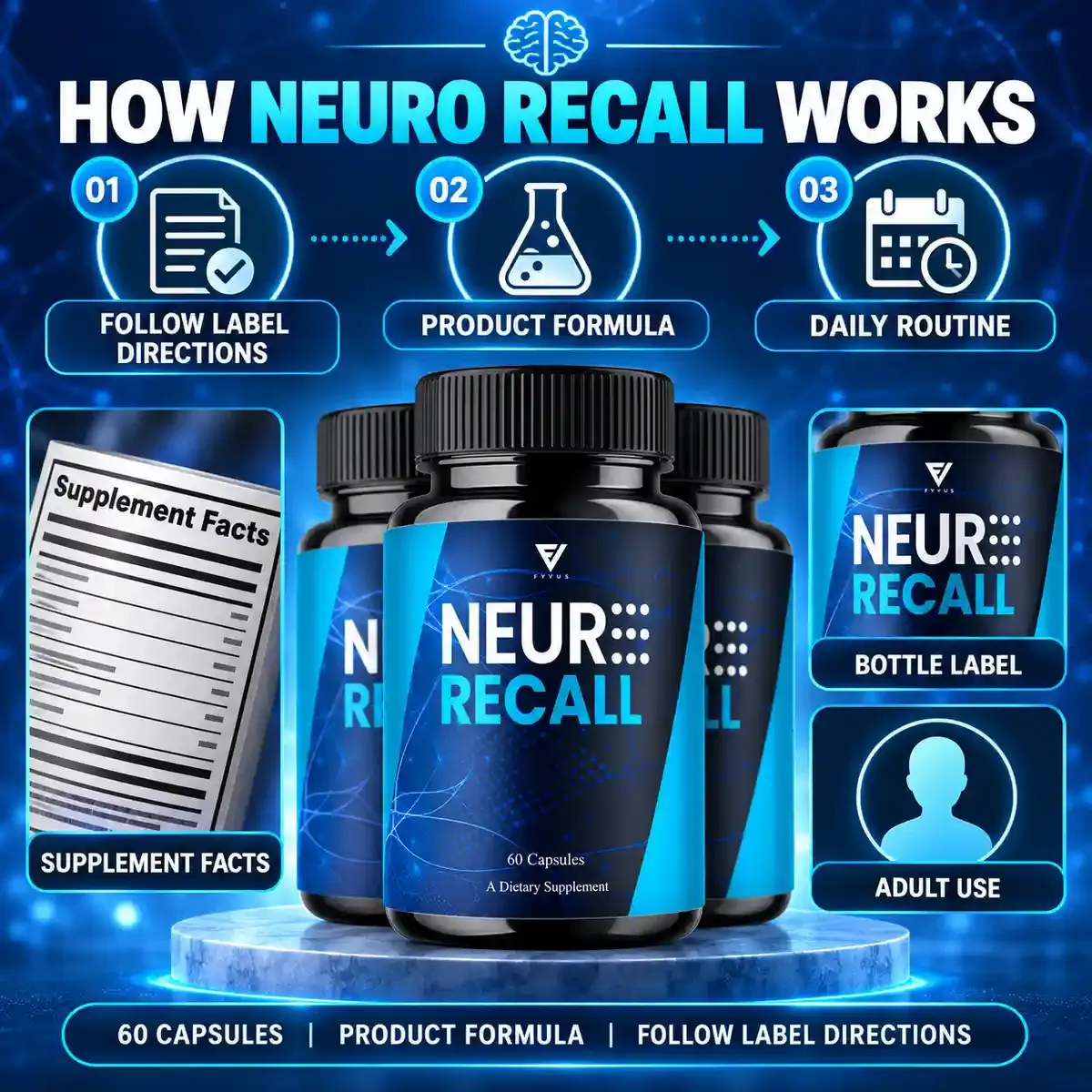
So the brand's answer is about habits, not biology. That leaves a gap, and the rest of this page fills it with what public research says about each ingredient on its own.
Here is how each line from the brand graphics holds up when you set it next to the bottle.
- On the label
Follow label directions
How-it-works graphicThe back label says 2 capsules daily, or as your provider directs.
- On the label
Daily routine
How-it-works graphicOne serving a day. The label sets no time of day.
- Marketing only
Designed to support mental clarity and focus
Benefits graphicA structure-function line with the FDA asterisk. Not tested in this product.
- Not shown
How the formula acts in the body
Not stated anywhereNo mechanism and no study of the full formula are given.
What does each ingredient group in Neuro Recall do?
The 14 ingredients in Neuro Recall sort into eight groups by what they were studied for. Tap a group to see the main finding and the dose that was tested.
B vitamins with printed amounts
B12 and folate
The body uses both for healthy nerves and blood cells. Low B12 can cause tiredness and nerve changes, and memory problems from low B12 are treatable (NIH ODS, Vitamin B12 (health professional)). In people whose levels are normal, extra B vitamins showed little to no effect on thinking.
Studied at: 500 mcg B12 plus 400 mcg folic acid a day for 2 years in one trial of adults 65 and over.
Minerals with printed amounts
Magnesium and chromium
Magnesium takes part in hundreds of body processes, yet memory trials of it are too few to judge (Adv Nutr 2024, Chen et al., Magnesium and cognitive health). Chromium is mostly studied for blood sugar; one 12-week trial in 26 older adults found mixed memory-task results.
Studied at: Chromium picolinate for 12 weeks; the daily amount was not stated on the record we read.
Herb with the most consistent small trials
Bacopa
Across nine trials with 518 people, bacopa sped up attention tasks such as Trail B and choice reaction time (J Ethnopharmacol 2014, Bacopa meta-analysis of RCTs). The effect was modest, and the authors asked for a larger trial.
Studied at: Standardized extract for 12 weeks or longer, usually 300 mg a day.
Herb with the largest trial
Ginkgo
Ginkgo is the most tested memory herb. In 3,069 adults aged 72 to 96, it did not lead to less decline than a placebo over about 6 years (JAMA 2009, Snitz et al., GEM cognitive decline trial).
Studied at: 120 mg twice a day, for a median of 6.1 years.
L-theanine and green tea extract
Tea compounds
L-theanine alone was linked to faster choice reaction time in the first hour after a dose (Nutr Rev 2025, Payne et al., tea and L-theanine meta-analysis). Tea's clearest effects came when caffeine and L-theanine were taken together; the label does not list caffeine.
Studied at: L-theanine 50 to 400 mg, with a median of 200 mg, in short trials.
Choline source
Alpha-GPC
Alpha-GPC supplies choline. It has been tested only in people who already had dementia, and no study has tested it in healthy people (Alzheimer's Drug Discovery Foundation, Alpha-GPC).
Studied at: 400 mg three times a day, 1,200 mg in total, in Alzheimer's trials.
Berberine, cinnamon and ALA
Blood-sugar plants
These three are studied for blood sugar, not memory. NCCIH calls the blood-sugar evidence weak and inconclusive (NCCIH, Diabetes and Dietary Supplements). Berberine also interacts with several medicines.
Studied at: No memory trials in people for any of the three.
Bilberry, lutein and zeaxanthin
Plant pigments
Lutein and zeaxanthin changed brain scans in small studies of older adults, but not clear memory scores (Nutrients 2021, Yagi et al., Lutein and brain health). Bilberry has not been clearly shown to help any health condition.
Studied at: 10 mg lutein plus 2 mg zeaxanthin a day for 12 months.
Only two of the eight groups, the vitamins and the minerals, have amounts on the label. For the other six, the dose in your capsules is unknown.
Thinking about Neuro Recall? Check today's packs on the official order page.
Money-back guarantee · Tracked US shipping · Secure checkout.
Can the 635 mg blend hold the doses that were studied?
No. A dose that worked in a trial would take up a large share of the blend, and several studied doses together would not fit at all. The table shows how much of the 635 mg each studied dose would need.
| Ingredient | Studied daily dose | Share of the 635 mg blend it would need |
|---|---|---|
| Bacopa monnieri | 300 mg | 47% |
| Ginkgo biloba | 240 mg | 38% |
| L-theanine | 200 mg (median) | 31% |
| Alpha-GPC | 1,200 mg | 189%, almost twice the blend |
| Lutein + zeaxanthin | 10 mg + 2 mg | 2% |
| Bacopa + ginkgo + L-theanine | 740 mg | 117%, more than the whole blend |
A proprietary blend lists names and a total weight, not single amounts, so no one can work out the dose of any one herb from the label (J Nutr, Perspectives on proprietary blends). Only the lutein dose is small enough that the blend could easily hold it.
The Neuro Recall Supplement Facts page shows what the order of the blend list can tell you.
Does a result for one ingredient carry over to Neuro Recall?
Not on its own. A trial result belongs to the dose, the extract, the length of use and the people in that trial. Change any of those, and the result may not hold (FTC, Health Products Compliance Guidance).
| Trial detail | In the studies | In Neuro Recall |
|---|---|---|
| Dose | Set, for example 300 mg of bacopa | Not printed for any blend ingredient |
| Extract strength | One bacopa trial used 55% bacosides | Bacopa at not less than 20% bacosides |
| How long | 12 weeks for bacopa; 6 years for ginkgo | No timeline on the label |
| Who took it | Healthy adults, or people with dementia for alpha-GPC | Sold to adults in general |
| What else was taken | One ingredient against a placebo | 14 ingredients at once, never tested together |
The 55% figure comes from a 12-week trial in 46 healthy adults (Rejuvenation Res 2013, Aguiar and Borowski, Bacopa review). Two capsules of Neuro Recall may hold a different extract at a different strength, and the panel only promises a floor of 20%.
How long each trial ran, and what that means for you, is on the Neuro Recall results timeline.
How far has the research behind Neuro Recall climbed?
Health research moves up in steps, from lab dishes to large trials. Most of the formula sits on the lower steps, and the top step, a trial of the product itself, has not been taken.
- Step 1
Lab and animal studies
Cinnamon and berberine stop here for memory. Their brain effects have not been confirmed in people (Alzheimer's Drug Discovery Foundation, Cinnamon).
- Step 2
Small human trials of one ingredient
Bacopa, L-theanine, chromium and lutein reached this step with small groups.
- Step 3
Large, long trials
Ginkgo reached this step. The answer was no benefit for decline.
- Step 4
A trial of the full formula
Not done. Neuro Recall itself has never been put through a published trial.
Animal and lab results alone are not enough to back a health claim, says the FTC. Our Neuro Recall ingredients guide lists where each of the 14 sits.
How Neuro Recall works: common questions
How does Neuro Recall work?
No study has tested Neuro Recall, so how the full formula acts is not known. Each ingredient was studied on its own: bacopa and L-theanine for attention, B12 and folate for people who are low, and several plant extracts for blood sugar.
Is Neuro Recall a medicine?
No. Neuro Recall is sold as a dietary supplement, and the label says it is not meant to diagnose, treat, cure or prevent any disease.
Do brain supplements work?
Some ingredients have small, early studies, but none has been shown to prevent dementia or cognitive decline. Results depend on the dose, which most brain blends, this one included, do not print.
Can supplements improve memory?
Only in narrow cases. B12 or folate helps when someone is low, and bacopa showed modest gains in attention after 12 weeks. In people with normal levels, extra B vitamins showed little to no effect.
What does bacopa do in Neuro Recall?
Bacopa is the ingredient with the most consistent small trials for attention speed, at about 300 mg a day for 12 weeks. The amount in Neuro Recall is not printed, and the whole blend is only 635 mg.
What does research say about the ginkgo in Neuro Recall?
The largest ginkgo trial gave 240 mg a day for about 6 years and found no less decline than a placebo. The ginkgo amount in Neuro Recall is not printed.
Why does Neuro Recall contain alpha-GPC?
Alpha-GPC is a source of choline. It has only been studied in people who already had dementia, at 1,200 mg a day, which is more than the whole 635 mg blend.
Is there research on Neuro Recall itself?
No. We found no published study of Neuro Recall. All the research on this page is about single ingredients.
Page check
Written by
Writes and fact-checks every page against the Supplement Facts panel, the back label and public health sources.
Medically reviewed by
Dr. Neelum Aggarwal, MD, Physician
Medical reviewer. Review date: October 12, 2026.
- Last checked October 11, 2026
- Facts from the bottle, the sales page and the sources cited above
- Found an error? Write to [email protected] or read how we check facts