Vitamin B12 and Folate in Neuro Recall: When They Help Memory
Quick answer
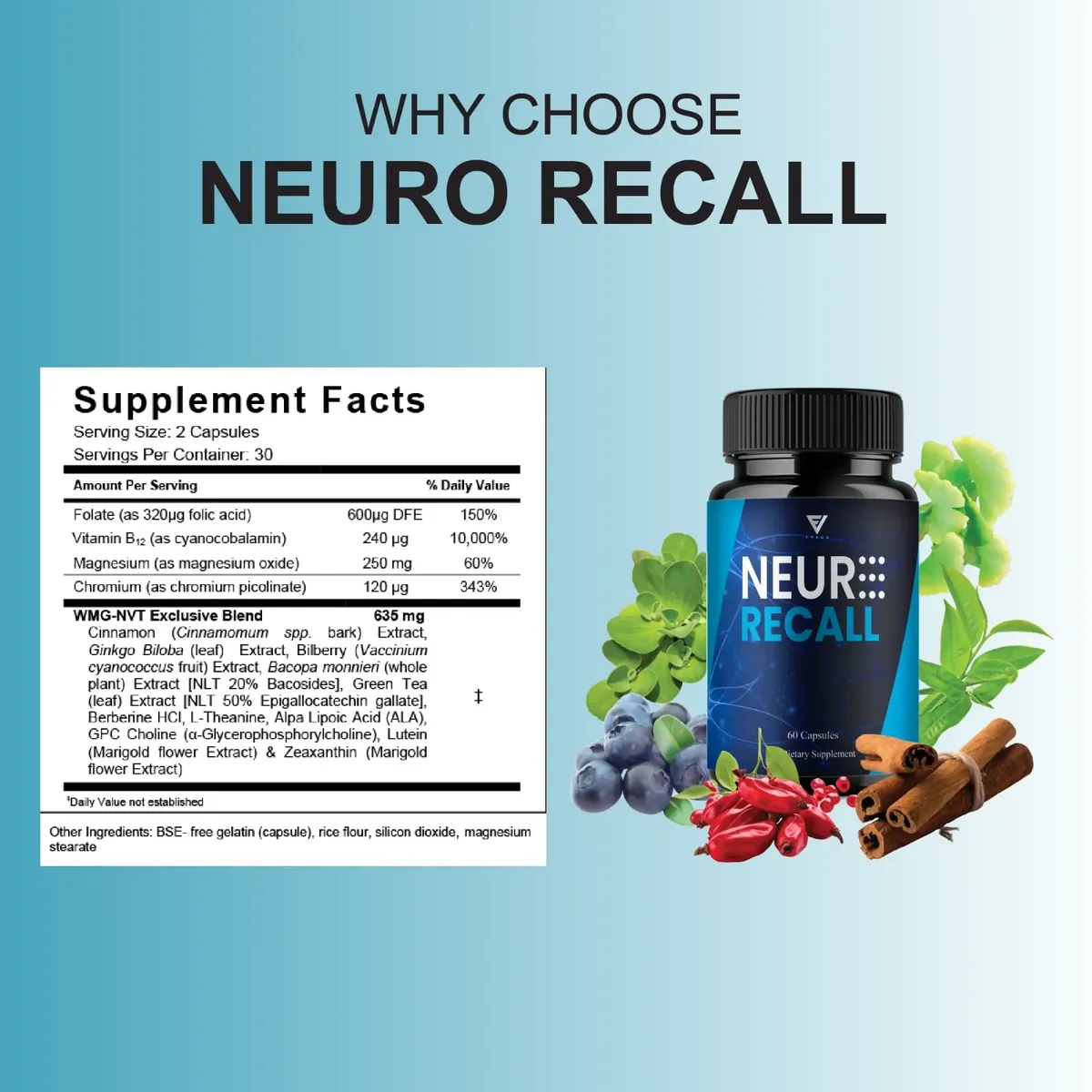
Each 2-capsule serving of Neuro Recall prints 240 mcg of vitamin B12 (10,000% DV) and folate at 600 mcg DFE, from 320 mcg of folic acid. Low B12 can cause memory loss, and a doctor should treat it. In people with normal levels, trials found B vitamins did not improve thinking. High folate can also hide a B12 deficiency, so get tested rather than guess.
What are vitamin B12 and folate?
Vitamin B12 and folate are two B vitamins. The body uses both to make healthy blood cells and to keep nerves working, and the brain is part of that nerve system.
Neuro Recall lists both at the top of its Supplement Facts panel, each with a printed amount. That makes them easier to judge than the ten ingredients in the blend below them, which have no single amounts. All 14 ingredients sit side by side in the Neuro Recall ingredients guide.
- Vitamin B12 on the label
- 240 mcg, as cyanocobalamin, 10,000% DV
- Folate on the label
- 600 mcg DFE, as 320 mcg folic acid, 150% DV
- Per
- 2 capsules, the full daily serving
- Upper limit for B12
- None set, because the risk of harm is low (NIH ODS, Vitamin B12 (health professional))
- Upper limit for folic acid
- 1,000 mcg a day for adults, from supplements and fortified foods (NIH ODS, Folate (health professional))
How are B12 and folate thought to help memory?
They help memory when the body is short of them. A low B12 level can cause tiredness and nerve changes, and those nerve problems can show up even when the blood count looks normal (NIH ODS, Vitamin B12 (health professional)).
When a level is normal, extra B vitamins do not seem to add anything. Think of a car with a full fuel tank: pouring in more fuel does not make it go faster.
Researchers also looked at homocysteine, a compound in the blood that runs high in some older adults. Folic acid lowers homocysteine in trials, but in most of them thinking did not improve (NIH ODS, Folate (health professional)).
Thinking about Neuro Recall? Check today's packs on the official order page.
Money-back guarantee · Tracked US shipping · Secure checkout.
What did studies of B12, folate and memory find?
Across large reviews, B vitamins did not improve thinking in older adults who were not low in them. The one bright spot was a group with high homocysteine, which shows the answer depends on who takes them.
| Source | Who and what dose | What it found |
|---|---|---|
| Cochrane review (Cochrane, Folic acid with or without B12 for cognition) | 8 placebo-controlled trials in healthy or memory-impaired older people; folic acid with or without B12 | No consistent evidence either way that thinking improved |
| Same Cochrane review | Healthy older people with high homocysteine; 800 mcg folic acid a day for 3 years | Better memory and processing speed |
| NIH folate fact sheet (NIH ODS, Folate (health professional)) | Meta-analysis of 11 trials, over 20,000 older adults; 400 to 2,500 mcg folic acid a day | No effect on thinking |
| NIH B12 fact sheet (NIH ODS, Vitamin B12 (health professional)) | Reviews of B vitamins in healthy people (up to 5 years) and in mild cognitive impairment (6 to 24 months) | Little to no effect in healthy people; no apparent effect in mild impairment |
| NCCIH (NCCIH, 7 Things To Know About Supplements and Alzheimer's) | Short-term B vitamin use in older adults | Did not improve thinking |
One trial the NIH cites gave 500 mcg of B12 with 400 mcg of folic acid a day for 2 years to adults aged 65 and older. Studies like it set the doses we compare with the label below.
Neuro Recall label amount vs. studied dose
Neuro Recall prints both amounts, so they can be checked. The B12 is about half of the lowest dose in the trials, and the folic acid is a little under the lowest folic acid dose.
| Nutrient | Neuro Recall per 2 capsules | Dose in trials | Label vs. lowest trial dose |
|---|---|---|---|
| Vitamin B12 | 240 mcg | About 500 to 1,000 mcg a day | 48% |
| Folic acid | 320 mcg (printed as 600 mcg DFE) | About 400 to 2,500 mcg a day | 80% |
- Folate line Folate (as 320 mcg folic acid). The name says which form is inside.
- 600 mcg DFE The folate amount in dietary folate equivalents, the unit the Daily Value uses.
- 10,000% The B12 Daily Value share. 240 mcg is 100 times the Daily Value the label uses.
- Serving size: 2 capsules Both amounts are for the full daily serving, not one capsule.
What the 10,000% DV means
It means the serving holds 100 times the Daily Value for B12. That sounds alarming, but no upper limit is set for B12 because the risk of harm is low. It is also not a benefit for someone whose level is already normal.
The DFE line, as printed
The label reads: Folate 600 mcg DFE (as 320 mcg folic acid), 150% DV. The 320 mcg is the weight of folic acid in the capsules. The 600 mcg DFE is the label's figure in dietary folate equivalents, a unit that allows for folic acid being taken up more easily than folate in food (NIH ODS, Folate (health professional)).
The 150% compares 600 with the 400 mcg DFE Daily Value. The 1,000 mcg upper limit applies to folic acid, so the number to hold against it is the 320 mcg. We quote the line as printed and do not recalculate it. Every other line is on the Neuro Recall Supplement Facts page.
Why a B12 test comes before a supplement
Low B12 is a treatable cause of memory loss, so it is worth finding rather than guessing at. The National Institute on Aging says it should be treated by a doctor (NIA, Forgetfulness: Knowing When to Ask for Help).
- 1
Notice the pattern
Note what slips, when and how often. Losing things often, missing appointments and trouble finding words are signs to raise.
- 2
Book a visit
Bring the note and every bottle you take, Neuro Recall included, so the doctor sees the full picture.
- 3
Ask about blood tests
The doctor decides which tests fit you. B12 and folate can both be checked with a blood test.
- 4
Treat what is found
If B12 is low, the doctor sets the dose and the follow-up. A memory supplement does not replace that plan.
Other treatable causes can look the same, including medicine side effects and thyroid, kidney or liver problems. Our memory and focus guide covers the everyday habits that sit alongside a check-up.
Can folic acid hide a B12 deficiency?
Yes, it can. NIH says high folate intakes might hide a B12 deficiency until nerve damage may become permanent, and that folate might also worsen the anemia and thinking symptoms of that deficiency (NIH ODS, Folate (health professional)).
Neuro Recall contains both folic acid and B12, so it is not a stand-in for a check-up. Tell the doctor you take it, so any results are read with that in mind.
Side effects, interactions and who should avoid it
At these amounts, B12 and folic acid are among the lowest-risk parts of the label. The cautions come from the rest of the capsule and from what else you already take.
| Point to check | What the sources say |
|---|---|
| B12 at 240 mcg | No upper limit set; low risk of harm |
| Folic acid at 320 mcg | Under the 1,000 mcg adult limit; count any multivitamin or B-complex toward it |
| Pregnant or nursing | The Neuro Recall label says do not use; choose a prenatal with your provider |
| New or worsening memory problems | See a doctor first; low B12 is one treatable cause |
Do not read "or as needed" on the back label as a reason to double up. A second serving would still keep folic acid under its limit, but it would push magnesium to 500 mg, over the 350 mg limit, as the Neuro Recall magnesium page explains.
Vitamin B12 and folate: common questions
Is vitamin B12 good for memory?
Only when someone is low in it. Reviews cited by NIH found B vitamin supplements had little to no effect on thinking in healthy people over up to 5 years.
Can low B12 cause memory loss?
Yes. The National Institute on Aging lists vitamin B12 deficiency among the causes of memory loss that a doctor should treat, and NIH says the nerve symptoms can appear even without anemia.
Does folate help with memory?
Not in most people. A meta-analysis of 11 trials in over 20,000 older adults found no effect of 400 to 2,500 mcg of folic acid a day on thinking; one group with high homocysteine did better on 800 mcg a day.
Does folic acid cause memory loss?
None of our sources says that. The concern is different: high folate can hide a B12 deficiency, and NIH says it might worsen the anemia and thinking symptoms of that deficiency.
Can folic acid hide a B12 deficiency?
It can. NIH says high folate intakes might hide a B12 deficiency until nerve damage may become permanent, which is why a blood test beats guessing.
Is 240 mcg of vitamin B12 too much?
No upper limit has been set for B12, because the risk of harm is low. That makes the 240 mcg in a serving of Neuro Recall a label fact, not a danger, but it is no extra help if your level is normal.
Which form of B12 is best?
NIH says no evidence shows that absorption differs by supplement form. Neuro Recall uses cyanocobalamin, a common form.
Does vitamin B12 prevent dementia?
No supplement has been shown to. NCCIH says direct evidence that supplements prevent dementia is lacking, and short-term B vitamin use has not improved thinking in older adults.
Why does the Neuro Recall label say 10,000% for B12?
Because 240 mcg is 100 times the Daily Value the label uses. A big percentage is normal for B12 products and does not mean a bigger effect.
Page check
Written by
Writes and fact-checks every page against the Supplement Facts panel, the back label and public health sources.
Medically reviewed by
Dr. Neelum Aggarwal, MD, Physician
Medical reviewer. Review date: October 12, 2026.
- Last checked October 11, 2026
- Facts from the bottle, the sales page and the sources cited above
- Found an error? Write to [email protected] or read how we check facts