How to Choose a Memory Supplement: Six Checks Before You Buy
Quick answer
Run six checks: amounts for every ingredient, doses near those used in human trials, modest claims, human evidence, safety with your medicines, and a seller you can reach. Proprietary blends hide single amounts, so their doses cannot be checked. Neuro Recall passes on claims and seller details but prints only a 635 mg total for ten ingredients.
What should you check before you buy a memory supplement?
Check six things: amounts for each ingredient, doses near the studied ones, modest claims, human evidence, safety with your medicines, and a seller you can reach. A product that passes all six is easier to judge.
These checks work for any brand. At the end we run Neuro Recall through the same list, including the checks it does not pass.
- 1
Amounts for every ingredient
Each ingredient has its own amount per serving, not just a blend total.
- 2
Doses near the studied ones
Each amount sits close to the dose used in human trials of that ingredient.
- 3
Claims that stay modest
No promise to treat, reverse or prevent memory loss or dementia.
- 4
Evidence for the right thing
Human trials, not lab dishes, animals or testimonials.
- 5
Safe with your medicines
No ingredient that clashes with what you already take.
- 6
A seller you can reach
A named seller, a phone line, a returns address and written refund terms.
How do you read a Supplement Facts label?
Read it top to bottom: serving size, the ingredients with amounts, any blend, then the other ingredients. Tap the numbered dots on the Neuro Recall panel to see each part.
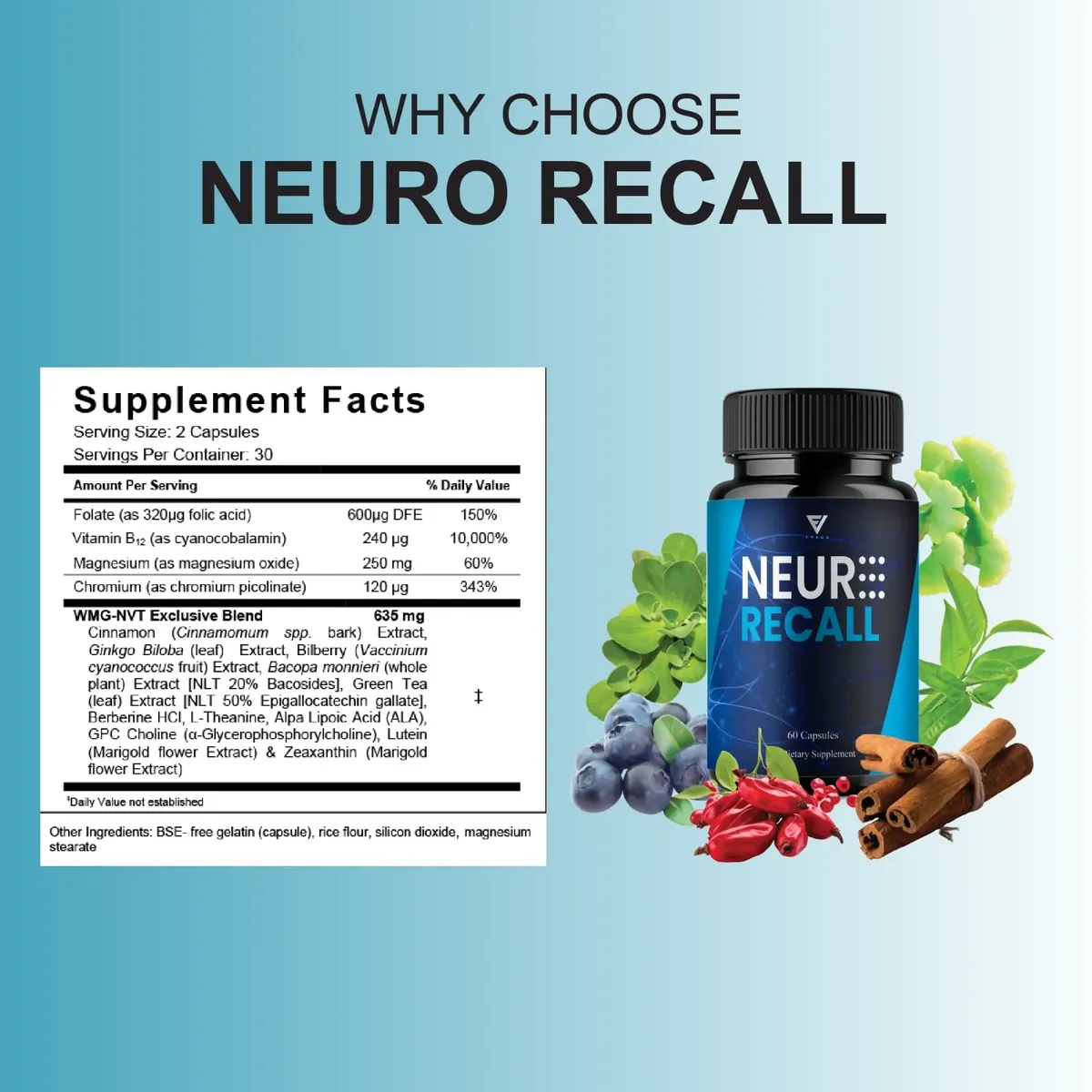
- Serving size Every amount below is for this serving. Here it is 2 capsules, so one capsule holds half.
- Nutrients with a Daily Value Vitamins and minerals must show an amount and a % DV. A high % DV is not the same as a benefit.
- The blend line One total weight for several ingredients, listed in order of weight. No single amounts.
- Other ingredients Capsule shell, fillers and flow agents. Check here for gelatin if you avoid it.
| Part of the label | What to look for | What the Neuro Recall label shows |
|---|---|---|
| Serving size | How many capsules make one serving | 2 capsules; 30 servings per bottle |
| Nutrient amounts | An amount and % DV for each | Folate 600 mcg DFE, B12 240 mcg, magnesium 250 mg, chromium 120 mcg |
| Herbs and other ingredients | An amount for each one | Ten share one 635 mg blend; single amounts not printed |
| Directions and warnings | Dose, who should not use it, storage | 2 capsules daily; warnings and storage on the back label |
Every line of this panel is explained on the Neuro Recall Supplement Facts page.
Thinking about Neuro Recall? Check today's packs on the official order page.
Money-back guarantee · Tracked US shipping · Secure checkout.
What is a proprietary blend, and why does it matter?
A proprietary blend lists several ingredients under one total weight, with no amount for each. FDA labeling rules ask for the blend's total weight and the ingredients in descending order of weight, and only ingredients with a Daily Value need their own amounts (FDA, Dietary Supplement Labeling Guide, Ch. IV).
Researchers writing in The Journal of Nutrition point out the problem for buyers: the label cannot be used to work out how much of any one ingredient a person takes (J Nutr, Perspectives on proprietary blends). Makers do not have to answer when asked.
Which doses were used in memory studies?
Compare each amount on a label with the dose used in human trials. A result belongs to its dose, and a much smaller amount may not do the same thing.
| Ingredient | Dose used in studies | What the trials found | Neuro Recall label |
|---|---|---|---|
| Bacopa monnieri | 300 to 450 mg a day, 12 weeks or more | Modest gains in attention speed and some recall (J Ethnopharmacol 2014, Bacopa meta-analysis of RCTs) (J Altern Complement Med 2012, Bacopa systematic review) | Not published |
| L-theanine | 50 to 400 mg, often 200 mg | Small short-term gains in reaction time and attention (Nutr Rev 2025, Payne et al., tea and L-theanine meta-analysis) | Not published |
| Ginkgo biloba | 240 mg a day for about 6 years | No less decline than placebo (JAMA 2009, Snitz et al., GEM cognitive decline trial) | Not published |
| Lutein + zeaxanthin | 10 mg + 2 mg a day for 12 months | Brain-scan changes, not clear memory gains (Nutrients 2021, Yagi et al., Lutein and brain health) | Not published |
| Alpha-GPC | 1,200 mg a day | Studied only in people with dementia (Alzheimer's Drug Discovery Foundation, Alpha-GPC) | Not published |
| Vitamin B12 | About 500 to 1,000 mcg a day | Helps thinking only when someone is low (NIH ODS, Vitamin B12 (health professional)) | 240 mcg |
| Folic acid | About 400 to 2,500 mcg a day | No effect on thinking in most trials (NIH ODS, Folate (health professional)) | 320 mcg |
For all 14 ingredients side by side, read Neuro Recall ingredients vs the research.
Which memory supplement ingredients interact with medicines?
Several common memory ingredients do. Ask your pharmacist before you start if you take any prescription, and bring the full ingredient list, not just the product name.
| Ingredient | Medicines to ask about | Source |
|---|---|---|
| Ginkgo | Blood thinners such as warfarin; may raise bleeding risk | (NCCIH, Ginkgo: Usefulness and Safety) |
| Berberine | Cyclosporine and medicines handled by the liver enzymes CYP2D6, 2C9 and 3A4 | (Memorial Sloan Kettering, Berberine (About Herbs)) |
| Berberine, chromium, cinnamon, alpha lipoic acid | Diabetes medicine; tell your provider about any of these | (NCCIH, Diabetes and Dietary Supplements) |
Our Neuro Recall side effects page collects every caution for this formula in one place.
What does the FTC say about memory and brain claims?
Health claims for supplements need competent and reliable scientific evidence, and the FTC calls randomized, controlled human trials the most reliable form. Animal and lab studies alone are not enough, and testimonials are never enough (FTC, Health Products Compliance Guidance).
A case about a different product
In 2017 the FTC and the New York Attorney General sued the makers of Prevagen over claims that it improved memory within 90 days (FTC, Prevagen complaint (business blog)). In December 2024 a federal court ordered the company to stop making misleading claims about it (FTC, Statement on win against Prevagen makers).
That case was about another brand. It is not about Neuro Recall or its maker. It matters to buyers because it shows how regulators read memory claims: the product must be backed by reliable human evidence, not by a story.
What are the red flags on a memory supplement?
Be careful with any product that promises too much or hides too much. These are the warning signs we look for on every memory label and sales page.
- Promises to reverse memory loss, cure dementia or prevent Alzheimer's.
- "Clinically proven" with no trial of the product itself.
- Results promised in a set number of days.
- Celebrity or doctor endorsements you cannot trace.
- A blend with no single amounts, sold as the whole reason to buy.
- No seller name, phone line or refund address.
- Marketing only
Promotes mental clarity and focus
Brand graphicA structure-function line with the FDA asterisk; not tested in this product.
- Not shown
Treats memory loss or dementia
Nowhere in the brand materialsGood: no disease claim appears.
How does Neuro Recall score on the six checks?
Neuro Recall passes on claims and seller details, and fails where amounts matter. Here is the honest tally.
| Check | Result | Why |
|---|---|---|
| Amounts for every ingredient | Partly | Four nutrients have amounts; ten blend ingredients do not |
| Doses near the studied ones | Cannot check | The blend split is not printed; B12 and folic acid sit below trial doses |
| Claims that stay modest | Yes | Structure-function lines with the FDA statement; no disease claim |
| Evidence for the right thing | Ingredients only | No study of this formula has been published |
| Safe with your medicines | Ask first | Ginkgo, berberine and blood-sugar ingredients need a pharmacist check |
| A seller you can reach | Yes | Neurorecallmemory, a phone desk and a New York returns address |
Unsure? Read the memory and focus guide first.
Choosing a memory supplement: FAQ
What supplements help memory and brain function?
No supplement is proven to improve memory in healthy adults. Bacopa, L-theanine and lutein have small, early studies at known doses, and B12 or folate help when someone is low. Ginkgo's largest trial found no benefit for decline.
What are the best memory supplements for seniors?
There is no proven best one. For older adults the most useful first step is a check-up, because low B12, medicines and thyroid problems can affect memory and are treatable. Then use the six checks on this page.
Are brain supplements FDA approved?
No. The FDA does not approve dietary supplements for safety or effectiveness before they are sold. A product sold to treat or prevent a disease is treated as a drug, even if it is labeled a supplement.
What is a proprietary blend on a supplement label?
It is a group of ingredients listed under one total weight. The label names each ingredient in order of weight but does not have to give the amount of each one.
How do I know if a memory supplement is legit?
Look for a full Supplement Facts panel, modest claims, warnings, and a seller with a phone line, address and written refund terms. Then check each ingredient against the doses used in human trials.
Can a memory supplement say it treats dementia?
No. A product meant to treat, prevent or cure a disease is treated as a drug. Supplement labels may only make structure or function claims, marked with the FDA statement.
Why does Neuro Recall not list each blend amount?
The label lists its WMG-NVT Exclusive Blend as one 635 mg total, which FDA labeling rules allow for ingredients without a Daily Value. The brand has not published the split.
Page check
Written by
Writes and fact-checks every page against the Supplement Facts panel, the back label and public health sources.
Medically reviewed by
Dr. Neelum Aggarwal, MD, Physician
Medical reviewer. Review date: October 12, 2026.
- Last checked October 11, 2026
- Facts from the bottle, the sales page and the sources cited above
- Found an error? Write to [email protected] or read how we check facts