Money-back guarantee · Tracked US shipping · Secure checkout
Neuro Recall Ingredients vs the Research: All 14 Label Lines Checked
Quick answer
Neuro Recall prints amounts for B12, folate, magnesium and chromium, all below or apart from memory trial doses. Ten more ingredients share a 635 mg blend with no single amounts. Bacopa, L-theanine and lutein have small early studies, ginkgo's large trial found no benefit, and four ingredients have no human memory studies. No study of the formula exists.
By the Neuro Recall Editorial DeskUpdated
Neuro Recall lists 14 ingredients on its Supplement Facts panel. Four come with exact amounts. Ten share one 635 mg blend. This post puts every line next to what human studies used and found, and shows where the label leaves you guessing.
What does the Neuro Recall label actually print?
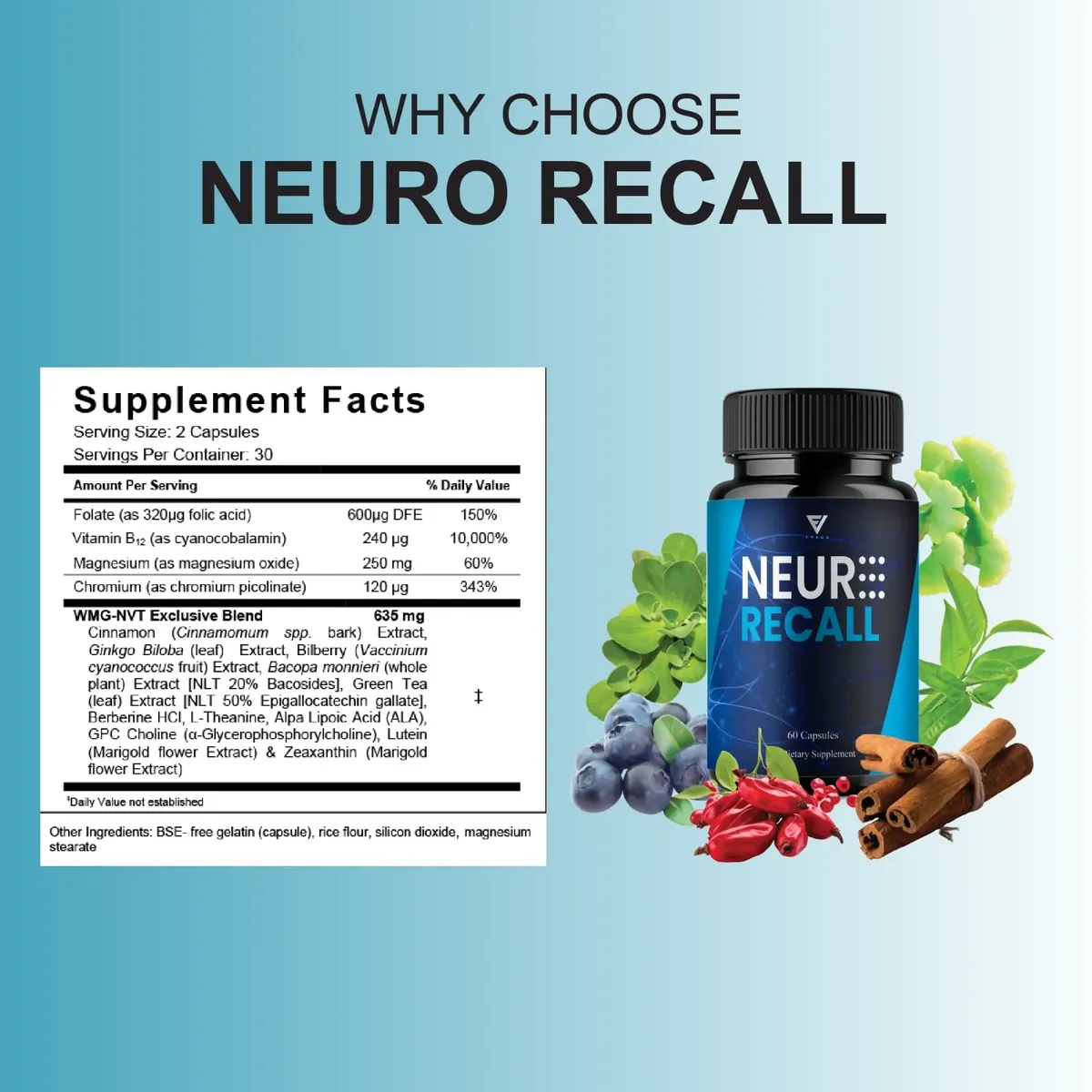
The panel lists a serving of 2 capsules and 30 servings per bottle. It gives amounts for folate, vitamin B12, magnesium and chromium, then one total for the WMG-NVT Exclusive Blend.
14ingredients on the panel
4with a printed amount
635 mgshared by the other ten
740 mgtrial doses of just three blend herbs
The brand's ingredient panel. It names the herbs and nutrients but, like the label, gives no amount for any of the ten blend ingredients.
Four amounts you can check
Folate 600 mcg DFE (as 320 mcg folic acid), vitamin B12 240 mcg, magnesium 250 mg as oxide, and chromium 120 mcg as picolinate. Each has a percent Daily Value.
Ten amounts you cannot
Ginkgo, bacopa, L-theanine, alpha-GPC and six more share 635 mg. The split is not printed.
Only B12 and folic acid can be set beside memory trial doses, because only they have printed amounts and trials to compare. B12 is 240 mcg against about 500 to 1,000 mcg in trials; folic acid is 320 mcg against 400 to 2,500 mcg.
Vitamin B12 and folate
Both sit below the doses used in trials. That matters less than it sounds, because a Cochrane review of eight trials found no consistent evidence that folic acid, with or without B12, improves thinking in unselected older people (Cochrane, Folic acid with or without B12 for cognition). These vitamins help when someone is low, which a blood test shows.
Do not double up: The label says 2 capsules daily "or as needed". Two servings would give 500 mg of magnesium, above the 350 mg upper limit for supplements, and oxide often causes diarrhea at high doses (NIH ODS, Magnesium (health professional)). Stay at 2 capsules a day unless a clinician says otherwise.
What does research say about the blend ingredients?
Four blend ingredients have human research worth a closer look. Turn each sheet over for the dose that was studied, what the trial found, and what to watch for.
Leaf extract
Ginkgo biloba
Ginkgo biloba
The best-studied memory herb. A large trial at 240 mg a day found no less decline; it can raise bleeding risk.
Ginkgo biloba: the research
Studied at
120 mg twice a day (240 mg) for a median of 6.1 years
How strong is the evidence for each Neuro Recall ingredient?
Mostly weak. Three ingredients have small, early positive studies, one has a large negative trial, two help only people who are low, and four have no human memory evidence that we could find.
All 14 Neuro Recall ingredients and the memory research behind each
No. Even if the blend held nothing else, it could not fit the trial doses of three of its ingredients at once.
Studied doses added up, against a 635 mg blend
Ingredient
Daily dose in the main trials
Running total
Ginkgo biloba
240 mg
240 mg
Bacopa monnieri
300 mg
540 mg
L-theanine
200 mg
740 mg
Alpha-GPC
1,200 mg
1,940 mg
By the third row the total is already past 635 mg, with seven more ingredients still to fit. An even split would be about 63.5 mg each, a fraction of most trial doses.
That is why ingredient studies cannot be read as results for Neuro Recall. Researchers note that label information cannot show how much of any one blend ingredient a person takes (J Nutr, Perspectives on proprietary blends).
What does this mean if you are thinking about Neuro Recall?
It means buying Neuro Recall is a choice made on its ingredient list, not on proof. You get printed B12, folate, magnesium and chromium, plus small unknown amounts of herbs that range from modestly studied to unstudied for memory.
If you want a studied dose of bacopa or L-theanine, this label cannot confirm it. If you might be low in B12, a blood test tells you more than any capsule.
The label does not say. Ginkgo is one of ten ingredients sharing a 635 mg blend, and the largest ginkgo trial used 240 mg a day without slowing decline.
Does Neuro Recall have enough bacopa to work?
No one can tell from the label. Bacopa trials used 300 to 450 mg a day for 12 weeks or more, and the bacopa amount in the 635 mg blend is not printed.
Which Neuro Recall ingredient has the best evidence?
Bacopa, with small trials showing modest gains in attention speed and recall. L-theanine and lutein have smaller, shorter or indirect results.
Is the 10,000% B12 in Neuro Recall too much?
No upper limit has been set for B12 because of its low risk of harm. A high percent DV is also not a benefit for people whose levels are normal.
Is the alpha-GPC in Neuro Recall a studied dose?
It cannot be. Alpha-GPC trials used 1,200 mg a day, nearly twice the whole blend, and they were in people who already had dementia.
Are the cinnamon and berberine in Neuro Recall for memory?
No memory studies in people support either one. Both are studied mainly for blood sugar, and the results there are weak or unclear.
Is the magnesium in Neuro Recall well absorbed?
Magnesium oxide is absorbed less completely than citrate, chloride, lactate or aspartate forms. The memory trials for magnesium of any form are too few to draw conclusions.